Time-Domain Impedance Boundary Conditions for Lattice Boltzmann Acoustics
Acoustic liners line the ducts of aircraft engines to absorb sound. They are characterised by a frequency-dependent impedance, while a lattice Boltzmann solver advances in time. The work consisted in turning this impedance into a wall boundary condition that the solver can apply efficiently at every time step, without resolving the liner geometry.
Work in preparation for publication. A minimal single-file D2Q9 solver, written as an initial test, is public on GitHub.
Normal-incidence tube. A wave packet reflects off the impedance wall on the right, for three liner models. The plots compare the reflection coefficient measured in the simulation with the target. Fitting the raw, band-limited data amplifies waves just above the band; completing the data outside the band first removes this.
Lined duct with grazing flow. A tone propagates over the CT73 liner (dashed section of the bottom wall) for three flow and frequency conditions. The plots compare the sound pressure level along the top wall with a finite-element solution of the same problem.
R&D Internship — ABB Research Center, Baden, Switzerland
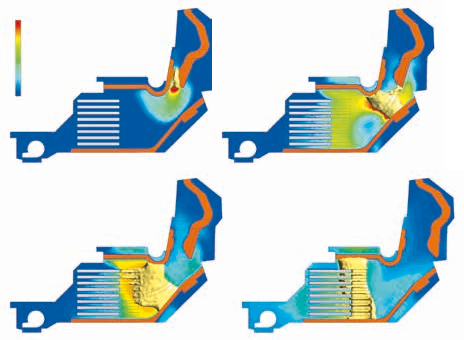
Circuit Breaker Simulation
Simulation tools for circuit breaker design, involving coupled electromagnetics, radiation transport, and fluid dynamics.
Contributed to a radiation transport model and reviewed the electromagnetic solver code.